


Syllabus: GS3/ Science & Technology
In Context
- Over the last decade, India has built a strong digital ecosystem that has transformed everyday interactions with technology through platforms such as UPI, Aadhaar, DigiLocker, UMANG and BHASHINI.
About
- India is projected to be the fastest-growing regional market in Asia Pacific, supported by its digital ecosystem, expanding middle class and rising e-commerce adoption.
- India’s immersive-tech market was about $1.26 billion in 2023 and is projected to reach $7.82 billion by 2030 (29.8% CAGR), the fastest in Asia-Pacific.
What are Immersive Technologies?
- Immersive technologies are technologies that create a simulated experience that can be perceived by the user as real.
- The three most common forms of immersive technology are Virtual Reality (VR), Augmented Reality (AR), and Mixed Reality (MR) & collectively, these technologies are often referred to as Extended Reality (XR).
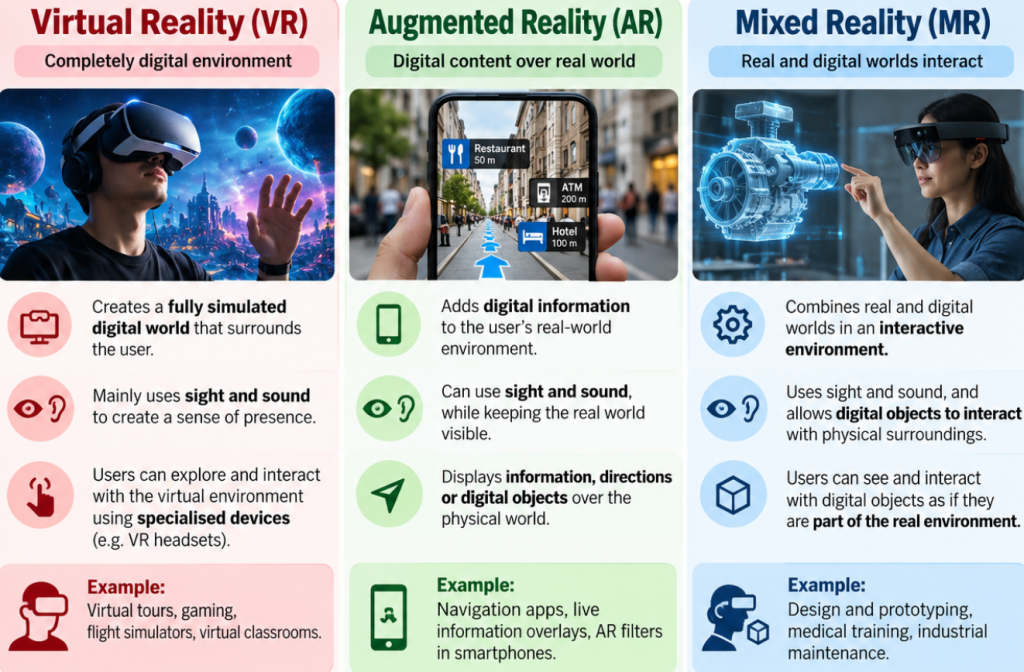
- The 360-degree video and Haptic Technology is also part of the wider immersive technology ecosystem.
- 360-degree video allows users to view a scene in every direction.
Applications of Immersive Technologies
- Education: IIT Madras is building AR/VR learning for rural schools, so a student can “walk” through a virtual lab instead of only reading about one.
- Heritage and tourism: The JATAN software digitises museum collections. The Indian Museum, Kolkata uses AI and AR features, and ASI museums at Hampi and Nalanda offer virtual tours.
- Governance: DoT’s “Sangam: Digital Twin” combines 5G, IoT and AI. Examples include Varanasi’s 3D urban planning and the Mobility Digital Twin used in Delhi and Ayodhya. Also, India aims for a National Digital Twin for major cities by 2035.
- Economy: The gaming sector is projected to grow from $3.8 billion (2024) to $9.2 billion by FY29.
Steps Taken by the Government of India in Immersive Technologies
- National Strategy for Additive Manufacturing and emerging technologies: Promotes advanced digital technologies and innovation.
- Digital India: Supports digital infrastructure and technology adoption, creating opportunities for XR applications.
- Smart Cities Mission: Enables the use of immersive technologies for urban planning, 3D visualisation and infrastructure management.
- Skill India Mission: Supports technology-enabled vocational training, including virtual simulations.
- IndiaAI Mission: Strengthens the AI ecosystem, which can support AI-enabled immersive applications.
- AVGC-XR framework: Immersive technology is supported through the Government’s broader AVGC-XR framework.
- The AVGC Promotion Task Force was constituted by the Ministry of Information and Broadcasting (MIB) in April 2022.
- On the Task Force’s recommendation, the Government set up a National Centre of Excellence (NCoE) to build skilled talent for the AVGC-XR sector. Later, the Indian Institute of Creative Technologies (IICT) was established in 2025.
- GENESIS (Gen-Next Support for Innovative Startups): To boost the startup ecosystem in Tier-II and Tier-III cities, MeitY approved the GENESIS Scheme to support around 1,600 tech startups over five years.
Advantages of using Immersive Technology
- Better learning outcomes: Makes complex subjects easier to understand through visualisation and simulation.
- Economic growth: Creates opportunities in gaming, animation, virtual production and immersive content.
- Employment generation: Opens new career paths in 3D modelling, XR design, software development and digital storytelling.
- Heritage preservation: Enables digital documentation and wider access to cultural assets.
- Improved governance: Digital twins can support urban planning, mobility analysis and infrastructure management.
- Strategic capability: Developing indigenous XR platforms and tools can reduce dependence on imported technologies.
Challenges
- High costs & heavy imports: Headsets and GPUs are expensive and mostly imported which puts them out of reach for many schools and small startups.
- Uneven connectivity: Real-time VR and digital twins need fast, low-latency networks as rural coverage is still not good.
- Shortage of skilled people: There are too few skilled trainers in game engines, spatial audio and computer vision.
- Health issues: Long sessions can cause eye strain and motion sickness, and children are especially vulnerable.
- Privacy risks: XR devices can capture eye movements, biometric data and even maps of a user’s room. Without safeguards, this is sensitive personal data at risk of misuse.
Way Forward
- Encourage domestic manufacturing of displays, sensors and lenses (a PLI-type incentive is a suggestion, not an announced scheme).
- Take XR skills into ITIs, polytechnics and engineering colleges.
- Build a public library of Indian heritage 3D assets so creators don’t start from zero.
- Frame child-safety rules and data norms early, in line with the DPDP Act.
- Put rural and Indian-language users at the centre, so that immersion doesn’t widen the digital divide.
Source: PIB
Previous article
The Rise in Youth Unrest and Underlying Reasons
